How Trademark Registration Really Works: Our Real Cost and Timeline
The moment you start using a name for your business, you have some claim to it. The trouble is that "some" is doing a lot of work in that sentence. How much you can actually do with a name, and how much it costs to make that claim solid, surprises most people the first time they look into it.
So rather than explain trademarks in the abstract, we will walk through a real one: our own. We registered the EMOZ trademark in the European Union, and the whole file is public. Here is what it took, what it cost and where a much lighter, faster option fits in.
What follows is the European route, filed at the EUIPO (the European Union Intellectual Property Office), so the fees, deadlines and office names are specific to it. The sequence travels well beyond Europe though, because filing, examination, publication, an opposition window and then registration is broadly how it works at the USPTO (the United States Patent and Trademark Office) and in most national offices, though the specifics vary and the US route can add further steps depending on the filing basis, so you should recognize the shape of it even where the details differ.
You may already have a (weak) trademark
In many countries, simply using a name in commerce gives you limited rights to it, so-called common-law or unregistered trademark rights. That is the difference between the two little symbols: ™ is a claim anyone can make on a mark they use, registered or not, while ® is reserved for a mark that has actually been registered.
But unregistered rights are thin. They usually reach only the area and market where you are already known, they are awkward to enforce, and they vary from country to country. In the European Union, where we registered, a registration generally gives you a much stronger and clearer position than relying on prior use alone. Earlier unregistered rights are not worthless and can, in some member states and in some circumstances, support an opposition or a challenge to a later mark, but they are harder to prove and narrower in reach. So if a name matters to your business, "we have been using it for years" is a far weaker position than "we registered it".
What registration actually buys you
A registered trademark turns a fuzzy claim into a clear, enforceable right across the whole territory: a public record that you own the mark for specific goods and services, a presumption of ownership if a dispute ever arises, the standing to stop others from registering a confusingly similar mark and the right to use the ® symbol with that mark for the goods and services it covers. For a brand you intend to build on, that is worth having.
What it looked like for us: the real EMOZ timeline
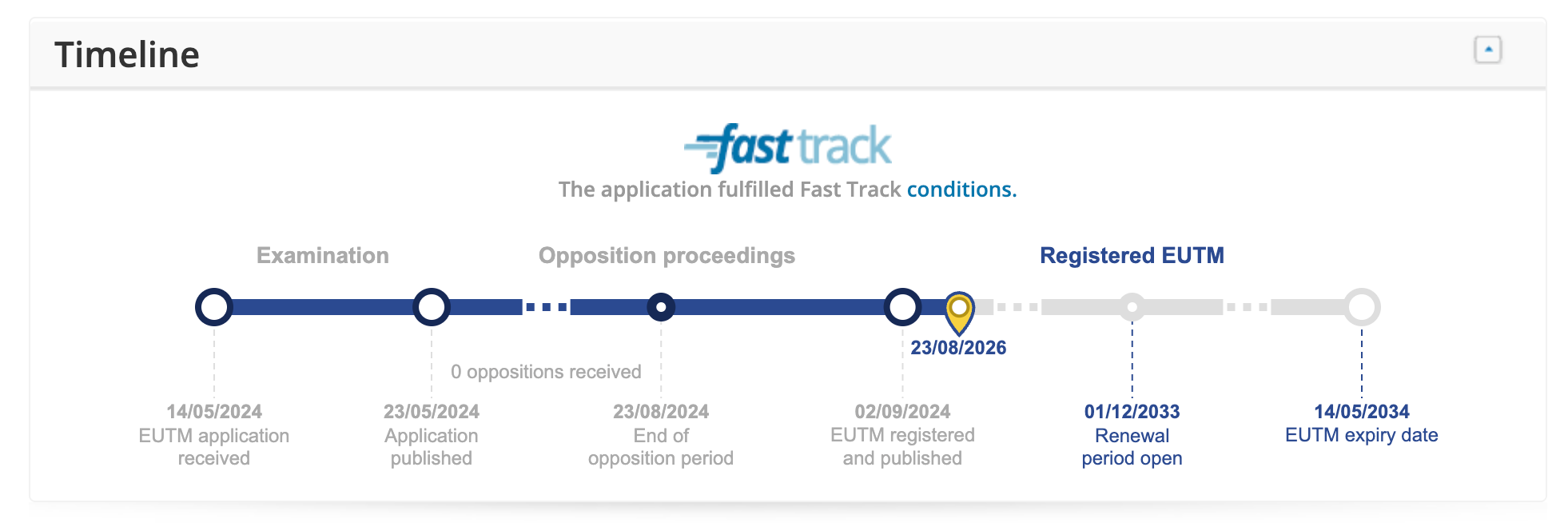
We filed the EMOZ word mark at the EUIPO on May 14, 2024. From there:
- it was published on May 23, 2024,
- the three-month opposition window closed on August 23, 2024 with zero oppositions,
- and the mark was registered on August 30, 2024 (the registration published on September 2).
Start to finish, about three and a half months. The registration runs for ten years, to May 14, 2034, and can be renewed indefinitely after that. Every step is on the public EUIPO record.
The opposition period: the wait nobody warns you about
That gap between "published" and "registered" is not the office being slow. Once your mark is published, the law gives the owners of earlier trademarks, and of certain other earlier rights, a three-month window to oppose it before it registers, in case it conflicts with something they already hold. If someone opposes, you are into a back-and-forth that can run for many months. If nobody does, as in our case, the mark proceeds to registration once the window closes. It is the single biggest reason a trademark is never a same-day thing.
Fast Track, and why we used it
The EUIPO offers a "Fast Track" route that gets your application examined and published sooner. The trade-off is that you play by its rules: you pick your goods and services from the EUIPO's pre-approved list (its Harmonised Database) instead of writing your own descriptions, and you pay the fees upfront. We did both, which is part of why ours went from filing to registration in roughly three and a half months. Worth being clear about what it does not do though: Fast Track speeds up examination and publication, and it leaves the three-month opposition window untouched, so that part runs its full course either way.
The bill: 1,050 euros
Here is the part people most want to know. When we applied in May 2024, an EU trademark started at a basic fee of 850 euros, which covered one class of goods or services. The second class was another 50 euros, and every class after that was 150 euros. We registered EMOZ in three classes, so the arithmetic was 850 + 50 + 150 = 1,050 euros (about 1,130 US dollars at the exchange rate then), paid by card, upfront. Those were the rates at the time and the EUIPO can revise its fee schedule, so check the current ones before you budget. That is before your own time, or a lawyer's if you use one. It is not nothing, especially for a young project.
Wait, what is a "class"?
Trademarks are not registered for "everything". They are registered for specific categories of goods and services, defined by an international system called the Nice Classification, which sorts everything into 45 numbered classes (1 to 34 for goods, 35 to 45 for services). You register in the classes that match what you actually offer, and you pay per class, which is exactly why the number of classes drives the cost.
EMOZ is registered in three: class 9 (our downloadable digital goods), class 42 (the technical services: blockchain, certification, encryption and storage) and class 45 (identity-verification and intellectual-property management services). The full, exact wording is on the public record. The takeaway is that each class you add broadens the ground you cover and your bill at the same time, though what you are actually protected for is the specific goods and services you list inside each class rather than the class as a whole.
So, should you register a trademark?
We are glad we did, and if you are building a brand you plan to invest in, a registration is the right tool and worth the money. But let us be honest about the other side: it is not automatic, it is not instant and it is not free. Not every project is at that stage. If you are early, testing an idea or working to a tight budget, it is perfectly reasonable to wait, or to start narrow with a single class and file a further application later if you need one. Worth knowing before you choose: you generally cannot widen the goods and services of an EU application once it has been filed, so adding a class later means a new application with a later filing date.
A different need, a fraction of the effort
There is one thing a trademark does not do, and it happens to be the thing creators most often actually need. A trademark protects your brand, the name and logo people recognize you by. It says nothing about whether a particular file, design, recording or draft existed, in your hands, on a particular date. That question, "can I prove I had this, and when?", comes up long before most people are ready to spend a thousand euros registering a mark.
That is exactly what timestamping is for, and it is the opposite of the trademark process in every practical way: instant instead of months, do-it-yourself instead of a filing, and a small fraction of the cost. You compute a fingerprint of your file and anchor it to a public record in seconds, from your browser, and the file itself never leaves your device. It does not replace a trademark, and it does not replace copyright. It sits alongside them as day-one evidence that your file existed, exactly as it is, on that date. We built EMOZ to do precisely that.
The bottom line
A trademark is the right tool for protecting a brand, and when you are ready to commit to one, the timeline and the thousand-euro-and-up bill are simply the price of a solid, enforceable right.
The order is the part people get wrong. Timestamping is the step with no reason to wait, because it takes seconds, costs less than a pizza and can be used for almost any digital file you make, including all the work that will never justify a filing. A trademark is a separate decision on its own timeline, and if a name or a piece of work already deserves one then the right time is now rather than someday. One never replaces the other, and the dated record you make today quietly backs up whatever you decide to file, whenever you file it.

 idea
idea