What Is Timestamping? Proof That Something Existed, Unaltered, at a Point in Time
You finish a song, a design, a research paper. Or you take a photo of a car right after an accident, or of a flat on the day you move in. Months later, someone asks a simple question: can you prove this existed, exactly as it is now, on the day you say it did?
Most people cannot. The file sits on a laptop with a date that anyone can change in a few clicks. The photo lives on a phone, or on a platform that could lose it or take it down. The honest answer is usually "trust me", and trust is not proof.
Timestamping is how you turn "trust me" into something anyone can check.
What timestamping actually means
The word is a little misleading. This is not the small date your computer writes next to a file, which is trivial to edit. A real timestamp is a proof, anchored to a public record, that a specific file existed in a specific state at a specific moment, and that it has not been altered since.
So it answers two questions at once:
- Existence: this exact thing existed no later than this date.
- Integrity: it has not been changed since then.
That combination is what makes it useful, and it is surprisingly hard to fake.
How it works, in plain terms
It rests on two simple ideas.
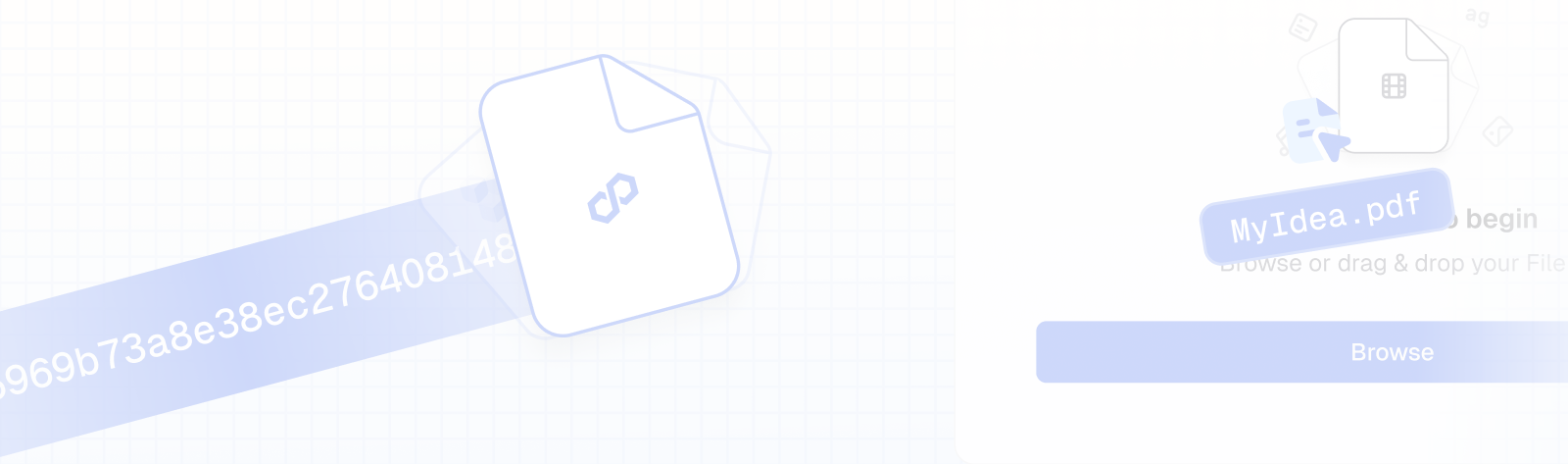
A fingerprint. Any file, of any size, can be reduced to a short, unique fingerprint using a standard calculation called SHA-256. The same file always produces the same fingerprint. Change a single pixel, comma, or note, and the fingerprint changes completely. The fingerprint reveals nothing about the contents, but it is a compact, tamper-evident stand-in for the exact file. You can calculate any file's fingerprint yourself, in your browser, with nothing uploaded.
A public anchor. That fingerprint is written to a public, append-only record, a blockchain, at a known moment. Once it is recorded, it cannot be quietly altered or backdated, and anyone can later check that this exact fingerprint was registered at that time.
Put together: you keep your file. The public record holds its fingerprint and the moment it was anchored. If your file is unchanged, its fingerprint still matches the record. If even one character was altered, the fingerprints will not match, and the change is obvious to anyone who checks.
What you can use it for
Timestamping is one simple idea with a lot of uses. A few of the common ones:
Protecting creative work. Songs, code, designs, writing. A timestamp is a fast, low-cost complement to copyright, not a replacement for it. It does not register or grant any rights, and it does not stop anyone from copying you. What it gives you is a clear, independently verifiable record that your work existed in this exact form on this date, which is a useful thing to be able to point to.
Photographs and situational records. A photo of a property at move-in or move-out, a car after a collision, the state of a building site on a given day. Here copyright is not the point at all. The point is being able to show that the image is authentic and was captured at that time, and has not been edited since.
Authenticity in the age of AI. As AI makes convincing fakes effortless, being able to show that your original existed, untouched, before a certain date becomes valuable. Timestamping does not prevent anyone from copying your work or training a model on it. What it does is let you prove what you made and when.
Online claims and webpages. Showing that a page or a public statement existed in a certain form on a certain date, without depending on a third party that might change or remove it later.
We will go deeper on each of these in future posts. The mechanism underneath is always the same: a fingerprint, anchored at a public moment.
Your file never leaves your device
There is a reasonable worry hiding in all of this. To prove a file exists, do you have to hand it over to some company?
With EMOZ, no. The fingerprint is computed in your browser, on your own device. Only the fingerprint, plus the few details you choose to include, is ever sent. The work itself, the song, the photo, the document, never leaves your machine. You get the proof without giving up the file. That is a deliberate design choice, and it is the part most services get wrong.
Proof that outlives the service
Because the fingerprint sits on a public blockchain, the proof does not depend on EMOZ continuing to exist. Anyone can verify, independently and permanently, that your fingerprint was recorded at that moment, using public tools that have nothing to do with us. The record cannot be removed or censored on request, not even by EMOZ. The proof is yours, and it lasts.
What it is, and what it is not
It is worth being precise, because some services in this space are not.
Timestamping is a fast, low-cost, tamper-evident, publicly and independently verifiable record that a file existed, unchanged, at a point in time.
It is not a grant of copyright or any other right, it is not a guarantee that no one will ever copy your work, and it is not a claim about what any particular institution will accept. It is a technical proof of existence and integrity. On its own, that is genuinely useful, and it is honest about what it does.
Try it
Creating a timestamp takes a couple of minutes, and your file stays on your device the whole time. If you have ever wanted a way to prove that something you made or captured existed, exactly as it is, on a specific day, that is the whole idea.

 idea
idea