Does "Poor Man's Copyright" Actually Work?
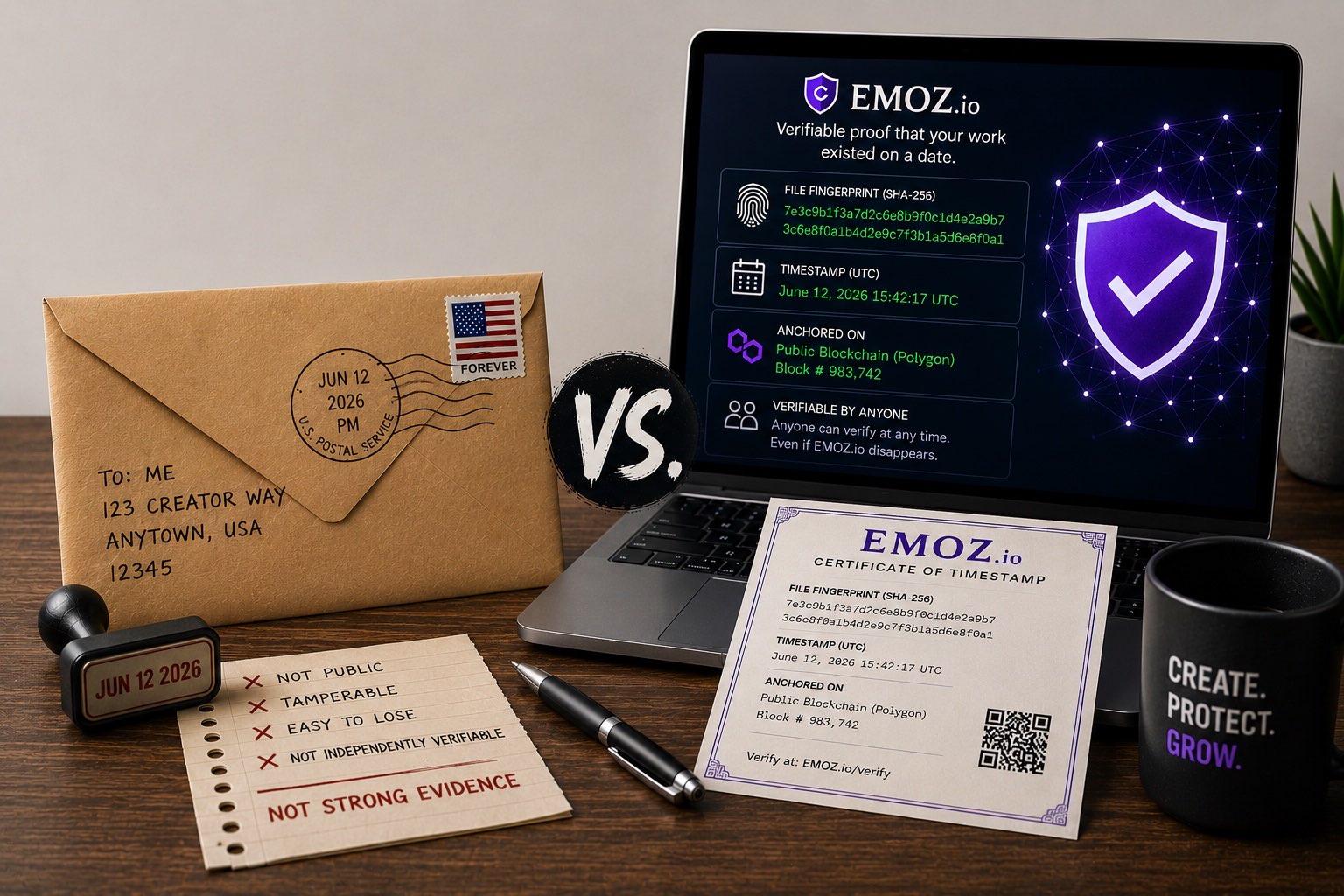
You finish a song, a manuscript or a logo, and someone gives you the old advice: print it, seal it in an envelope, mail it to yourself and never open it. The postmark, the story goes, proves you had the work on that date. It even has a name: the "poor man's copyright".
It costs a stamp, it feels official, and generations of creators have sworn by it. So does it actually work?
First, a fact that surprises most people
You don't need any trick for copyright to exist. In every country that signed the Berne Convention (182 of them, which is nearly the whole world), copyright arises automatically as soon as there is a record in any form of what you created. Write the song, save the file, and the rights are yours. No envelope, no registration, no ritual.
So the poor man's copyright was never about getting copyright. It is about something else: evidence. If a dispute ever comes, you want to show that your version of the work existed, in your hands, on a certain date. That is the problem the envelope is supposed to solve.
And as a solution to that problem, it is remarkably weak.
What the envelope actually proves
Think about what a sealed, postmarked envelope demonstrates: that an envelope passed through the postal system on a certain date. That's it.
- The postmark dates the envelope, not the contents. Envelopes can be mailed unsealed and filled later, and a sealed flap can be opened and resealed. Nothing binds the date on the outside to the work on the inside.
- You are the only custodian of the evidence. The envelope sits in your drawer. There is no public record, nothing a third party can look up and verify independently. Whoever examines it must simply trust that you didn't tamper with it.
- It is a single physical object. Lose it, open it by mistake, survive a house move badly, and your "proof" is gone forever.
Don't take our word for it. The US Copyright Office answers the question directly in its own FAQ: "There is no provision in the copyright law regarding any such type of protection, and it is not a substitute for registration". The UK Intellectual Property Office used to describe the practice in its copyright FAQ (deposit a copy with a bank or solicitor, or post one to yourself by special delivery) and warned in the same breath that "this does not prove that a work is original or created by you". That page has since been retired; the advice did not age well.
When the two institutions that administer copyright in the US and the UK both shrug at a method, that tells you something.
The modern variant is not better
The digital generation replaced the envelope with an email to yourself. Same idea, same weakness: the date on an email is metadata sitting in a mailbox that you (or your provider) control. It is a line of text, not a tamper-evident record. As evidence, it convinces nobody who doesn't already trust you.
What good evidence of existence looks like
Strip the problem to its essence and the requirements become clear. Evidence that a work existed on a date is only worth something when:
- It doesn't depend on trusting you. The record lives somewhere public and neutral, outside your drawer and your inbox.
- Tampering is detectable. Any change to the work after the fact must be evident, not merely deniable.
- Anyone can verify it, at any time. A third party should be able to check the claim independently, years later, without asking your permission (or anyone's).
This is precisely what timestamping does. Instead of sealing the work in an envelope, you compute its SHA-256 fingerprint, or hash (a short string that changes completely if a single byte of the file changes) and anchor that fingerprint to a public, append-only record with a date nobody can backdate. The work itself stays private; the fingerprint is meaningless to anyone who doesn't hold the file. But the day you need to demonstrate "this exact file existed on this date", the mathematics does the talking instead of an envelope.
That is what EMOZ was built for: drag in a file, the fingerprint is computed in your browser (the file never leaves your device) and gets anchored on a public blockchain, and you receive a certificate that anyone can verify independently, even if EMOZ disappeared tomorrow. It takes about a minute, and you can try it for free.
Should you still register your copyright? Yes.
We'll be explicit about this, because some services in this space are not: a timestamp is a complement to copyright registration, not a replacement. Registration is a formal legal instrument, and in some jurisdictions it carries benefits no timestamp can offer (in the US, for instance, timely registration is a prerequisite for statutory damages in infringement suits). If your work justifies it, register it.
What a timestamp gives you is the thing the poor man's copyright always promised and never delivered: verifiable evidence of what existed and when. The two tools are also worlds apart in cost and speed: registering a copyright means forms, official fees and a wait of weeks or months before the certificate arrives, while timestamping a file takes seconds and costs about as much as a couple of coffees. For this reason, the combination is a no-brainer: timestamp your work the moment it exists, and register it when it justifies the investment. The timestamp covers you from day one; the registration strengthens you for the long run.
The bottom line
The poor man's copyright survives because the instinct behind it is exactly right: creators need dated evidence of their work, and they need it cheaply. The instinct deserves better tools than the postal service. Keep the stamp for postcards.

 idea
idea